 Environmental Building Board
 Fire-proof Board
 Sound Resistance
 Termite Resistance
Leave Your Message
Choosing the right Waterproof Mgo Board can determine whether a global building project remains durable, safe, and financially controlled. Product labels alone are not enough. A board that performs well in a dry warehouse may react differently near coastal air, heavy rain, or repeated freeze-thaw cycles.
Experienced project teams examine more than water resistance. They check thickness, density, edge strength, screw-holding capacity, surface compatibility, and dimensional stability. A sample panel should be tested under realistic conditions, such as 24-hour moisture exposure, wet cutting, and installation with the proposed framing system. Small details matter. Poorly sealed joints can undermine a strong board.
Regional requirements also deserve careful review. Fire performance, emissions, structural use, and installation practices may vary between countries and project types. Reliable manufacturers should provide current technical data, test reports, batch information, and clear installation guidance. Independent verification is valuable, especially when documents appear incomplete or overly general.
Not every “waterproof” claim means permanent immersion resistance. That distinction is easy to miss. Procurement teams should confirm how the product was tested and what warranty limitations apply. Questions about transport, packaging, storage humidity, and replacement lead times can prevent costly delays. A pallet damaged by rain is not a minor issue.
This guide explores practical ways to compare Waterproof Mgo Board for international projects. It considers performance, documentation, supplier credibility, and site realities. The best choice is rarely the cheapest board. It is the board that performs predictably, fits local requirements, and remains supportable after installation. Even careful decisions need review. Specifications can change, and assumptions can fail.
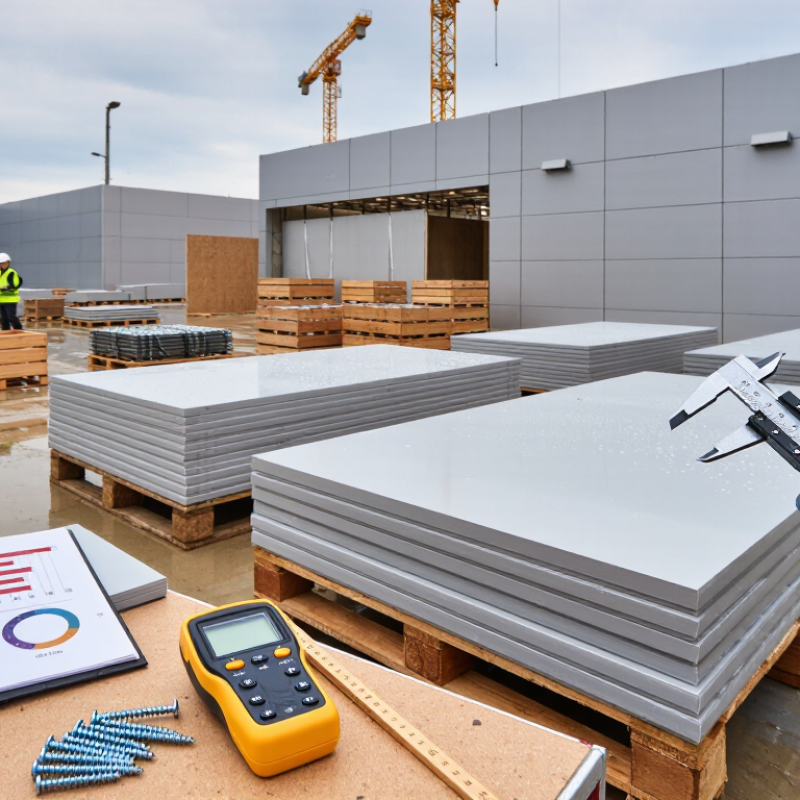
Waterproof MgO board is a magnesium oxide panel engineered to resist liquid water, humidity, and repeated wetting. It is not automatically waterproof because it contains magnesium oxide. The term should describe tested performance, not marketing language. A reliable board should maintain strength, shape, and surface integrity after water exposure, drying, and temperature changes. Core data should include water absorption, thickness swelling, wet strength, dimensional stability, and resistance to mold growth. Fire behavior and vapor permeability also matter, especially in external walls and humid interiors.
Testing conditions deserve close attention. Ask for independent laboratory reports, sample thickness, curing time, exposure duration, and the exact test method. Results from one climate cannot represent every global project. A board may perform well in a dry test but weaken around unsealed edges. That detail is easy to miss. Check fastener holding, joint treatment, sealant compatibility, and corrosion risks before approval. Local building codes still control the final specification.
Tips: Request wet-dry cycle results, not only a single water-absorption figure. Inspect cut edges after soaking. Confirm storage requirements at the jobsite. I would also compare several test reports instead of trusting one impressive number. No board is perfect. Installation errors can defeat good material performance. A waterproof claim should remain credible under real rain, poor ventilation, and repeated maintenance delays.
| Selection Dimension | What It Means for a Waterproof MgO Board | Practical Screening Data or Acceptance Basis | Relevant Test Method or Verification | Global Project Application |
|---|---|---|---|---|
| Board Composition | The board should use magnesium oxide as its primary cementitious binder together with reinforcing fibers, fillers, and additives appropriate for the specified exposure. | Request a current technical data sheet, safety data sheet, and declaration of composition. Confirm whether the panel contains chloride-related ingredients that may create corrosion risks in metal framing. | Product formulation review, chloride-content declaration where relevant, and independent laboratory testing when required by the project specification. | Important for steel-framed walls, ceilings, façades, transport projects, and coastal or high-humidity locations. |
| Water Absorption | Water absorption indicates how much water the board takes up after exposure. Lower absorption generally supports better dimensional stability, but it does not by itself prove that the board is waterproof. | Compare results using the same test procedure, specimen condition, immersion time, and board thickness. Treat the manufacturer’s declared value as product-specific rather than as a universal MgO-board limit. | Use a documented water-absorption procedure specified by the project or an applicable product standard. Review both total absorption and post-drying recovery. | Useful for wet rooms, soffits, exterior sheathing, and areas exposed to intermittent rain or condensation. |
| Water Resistance and Wet–Dry Cycling | Water resistance describes whether the panel retains its integrity, strength, and surface quality after repeated wetting and drying. | Check for no visible delamination, severe edge breakdown, powdering, or unacceptable cracking after the specified cycle test. Dimensional and strength changes should be reported, not just visual observations. | Require a documented wet–dry cycling test with cycle count, water temperature, drying conditions, specimen size, and pass/fail criteria. | Particularly relevant to façades, rainscreen systems, bathrooms, kitchens, basements, and buildings with seasonal humidity changes. |
| Dimensional Stability | Dimensional stability is the board’s ability to resist swelling, shrinkage, warping, and joint movement caused by changes in moisture and temperature. | Use the declared linear movement, moisture movement, and thickness-swelling values. The acceptable limit must match the joint design, fastener spacing, finish system, and climate. | Review moisture-movement and dimensional-change testing under controlled humidity and temperature conditions. | Critical for long wall runs, tiled substrates, exterior sheathing, prefabricated panels, and projects with large day–night temperature variations. |
| Vapor Permeability | Vapor permeability measures how readily water vapor passes through the board. A water-resistant board can still be vapor permeable. | Select the board according to the complete wall build-up, including insulation, membranes, cavities, and interior finishes. Do not select solely by the lowest vapor-transmission value. | ASTM E96 or an equivalent regional vapor-transmission method, with the test direction and wet-cup or dry-cup condition clearly stated. | Essential for cold climates, air-conditioned buildings, high-humidity regions, and walls requiring condensation-control analysis. |
| Liquid-Water Management | A board is only one part of a waterproof wall or ceiling assembly. Joints, penetrations, flashings, membranes, sealants, and drainage paths control most water-entry risks. | Specify joint treatment, edge sealing, fastener treatment, compatible membranes, and minimum clearances. Provide a drainage cavity where the façade design requires one. | Review the tested wall assembly, façade details, water-penetration test, and installation manual rather than relying on a standalone board claim. | Required for rainscreen façades, exterior walls, wet-area partitions, roofs, balconies, and exposed soffits. |
| Mechanical Strength | The board must withstand handling, fastening, impact, and service loads without unacceptable fracture or pull-out. | Compare flexural strength, modulus, impact resistance, fastener pull-through, and screw pull-out results for the intended thickness and support spacing. | Use the project’s specified structural or product test methods. For non-asbestos fibre-cement-type performance comparisons, ASTM C1185 or ASTM C1186 may be relevant where applicable, but they are not universal MgO-board standards. | Important for exterior sheathing, partitions, ceilings, tile backer applications, and areas subject to impact or wind load. |
| Fire Performance | Fire performance includes reaction to fire, flame spread, smoke production, combustibility, and fire resistance of the complete assembly. | Do not use “non-combustible” as a substitute for a fire-resistance rating. Confirm the required classification or resistance period for the complete tested wall, floor, or ceiling system. | Examples include EN 13501-1 for reaction-to-fire classification, ASTM E84 for surface burning, and ASTM E119 or EN 1364/1365 for fire-resistance testing, subject to local code requirements. | Relevant to high-rise buildings, public facilities, corridors, plant rooms, façades, and compartmentation systems. |
| Freeze–Thaw Resistance | Freeze–thaw resistance indicates whether moisture-saturated boards can withstand repeated freezing and thawing without serious deterioration. | Require test results when the board may become wet and the project is located in a freezing climate. Check edge condition and coating compatibility after cycling. | Use a documented freeze–thaw procedure appropriate to the product and project, including saturation level, cycle number, temperature range, and damage assessment. | Important for exposed façades, cold-storage surroundings, unheated buildings, balconies, and northern or mountainous regions. |
| Corrosion Compatibility | Some MgO formulations may create an alkaline or chloride-related environment that affects metal framing, fasteners, brackets, or electrical components. | Verify chloride-related data where available and specify corrosion-resistant framing and fasteners compatible with the board and exposure category. | Review chemical analysis, corrosion-compatibility evidence, fastener recommendations, and project-specific material compatibility testing. | Especially important for galvanized steel, aluminum, coastal buildings, high-humidity interiors, and mixed-material façades. |
| Thickness and Density | Thickness and density affect handling, stiffness, acoustic performance, fire behavior, fastener selection, and overall wall weight. | Common commercial thicknesses are often in the approximate range of 6–20 mm, while product density can vary widely, commonly around 750–1,200 kg/m³. Always use the declared product value for design calculations. | Confirm dimensional tolerances and density using the manufacturer’s controlled production data or independent inspection records. | Helps coordinate structural loads, panel cutting, transportation, lifting, and compatibility with standard framing systems. |
| Surface and Edge Treatment | Factory-sealed surfaces and edges can reduce liquid-water uptake and improve compatibility with coatings, membranes, sealants, and tile systems. | Identify whether the board is coated, sanded, primed, sealed, or unfinished. Confirm the required primer, joint compound, tape, sealant, and coating system. | Review system compatibility data and carry out a representative adhesion or water-exposure mock-up before large-scale installation. | Important for tiled wet areas, painted interiors, exterior coatings, and prefabricated construction. |
| Installation and Joint Design | Correct support spacing, screw placement, joint gaps, sealants, and movement joints are necessary to maintain water resistance and prevent cracking. | Follow the tested assembly details. Verify board orientation, minimum edge distance, fastener spacing, joint width, sealant type, and treatment of cut edges. | Use the project installation specification, manufacturer’s installation manual, and a site quality-control checklist. | Determines whether laboratory performance can be achieved in real construction under local labor and weather conditions. |
| Quality Assurance and Traceability | Consistent production is necessary because water resistance, strength, and dimensional stability can vary between formulations and batches. | Request batch numbers, production dates, inspection records, declared tolerances, certificates, and recent independent test reports. Sample incoming shipments when the risk level justifies it. | Factory quality-control review, third-party inspection, batch sampling, and comparison with the approved technical submittal. | Valuable for international procurement, large developments, government projects, and multi-phase construction. |
| Environmental and Regulatory Compliance | Global projects may require documentation for chemical safety, emissions, waste handling, recycled content, and local building-code compliance. | Check applicable declarations and restrictions for the destination market. Confirm that the documentation applies to the exact board formulation and thickness. | Review safety data sheets, environmental product declarations where available, material declarations, and country-specific conformity documentation. | Necessary when importing materials across jurisdictions or pursuing green-building and public-sector requirements. |